
Modes and Ragas: More Than just a Scale
Summary: Many musical traditions, in history as well as in the modern world, are based on modes or ragas rather than on major and minor scales.
Introduction
In many music traditions, including Western music, the list of all the notes that are expected or allowed in a particular piece of music is a scale. A long tradition of using scales in particular ways has trained listeners to expect certain things from a piece of music. If you hear a song in C major, for example, not only will your ear/brain expect to hear the notes from the C major scale, it will expect to hear them grouped into certain chords, and it will expect the chords to follow each other in certain patterns (chord progressions) and to end in a certain way (a cadence). You don't have to have any musical training at all to have these expectations; you only need to have grown up in a culture that listens to this kind of music. The expectations for music in a minor key are a little different than for music in a major key. But it is important to notice that you can move that song in C major to E major, G flat major, or any other major key. It will sound basically the same, except that it will sound higher or lower. In the same way, all minor keys are so alike that music can easily be transposed from one minor key to another. (For more on this subject, see Major Scales, Minor Scales, Scales that aren't Major or Minor, and Transposition.) This sameness is not true for musical traditions that use modes instead of scales. In these traditions, the mode, like a scale, lists the notes that are used in a piece of music. But each mode comes with a different set of expectations in how those notes will be used and arranged.Comparison of Scale and Mode
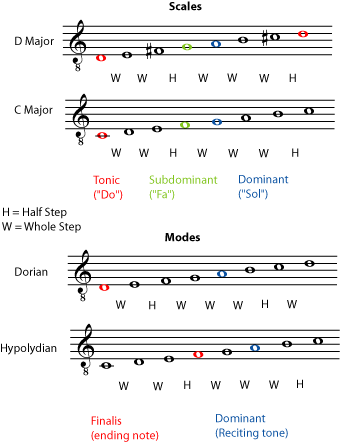 Figure 1: Compare the differences
and similarities between the two major scales, and the differences and
similarities between the two medieval church modes.
Figure 1: Compare the differences
and similarities between the two major scales, and the differences and
similarities between the two medieval church modes.
|
The Classical Greek Modes
We can only guess what music from ancient Greek and Roman times really sounded like. They didn't leave any recordings, of course, nor did they write down their music. But they did write about music, so we know that they used modes based on tetrachords. A tetrachord is a mini-scale of four notes, in descending pitch order, that are contained within a perfect fourth (five half steps) instead of an octave (twelve half steps).Tetrachords
 Figure 2: Here are three possible
Greek tetrachords, as nearly as they can be written in modern
notation. The outer notes are a perfect fourth apart; we can be pretty
certain of that, since the perfect fourth is a natural interval
playable, for example, on many ancient wind instruments (See
The
Harmonic Series and
Interval).
The actual tuning of the inner notes can only be guessed, however,
since our
equal
temperament is a relatively modern invention.
Figure 2: Here are three possible
Greek tetrachords, as nearly as they can be written in modern
notation. The outer notes are a perfect fourth apart; we can be pretty
certain of that, since the perfect fourth is a natural interval
playable, for example, on many ancient wind instruments (See
The
Harmonic Series and
Interval).
The actual tuning of the inner notes can only be guessed, however,
since our
equal
temperament is a relatively modern invention.
|
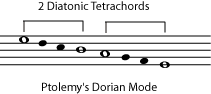 Figure 3: Each Greek mode was
built of two tetrachords in a row, filling an octave.
Figure 3: Each Greek mode was
built of two tetrachords in a row, filling an octave.
|
We have very detailed descriptions of tetrachords and of Greek music theory (for example, Harmonics, written by Aristoxenus in the fourth century B.C.), but there is still no way of knowing exactly what the music really sounded like. The enharmonic, chromatic, and diatonic tetrachords mentioned in ancient descriptions are often now written as in the figure above. But references in the old texts to "shading" suggest that the reality was more complex, and that they probably did not use the same intervals we do. It is more likely that ancient Greek music sounded more like other traditional Mediterranean and Middle Eastern musics than that it sounded anything like modern Western music. Modern minor keys are often considered better suited for different moods than major keys. One interesting aspect of Greek modes is that different modes were considered to have very different effects, not only on a person's mood, but even on character and morality. This may also be another clue that ancient modes may have had more variety of tuning and pitch than modern keys do.
The Medieval Church Modes
Sacred music in the middle ages in Western Europe - Gregorian chant, for example - was also modal, and the medieval Church modes were also considered to have different effects on the listener. (As of this writing the site Ricercares by Vincenzo Galilei had a list of the "ethos" or mood associated with each medieval mode.) In fact, the names of the church modes were borrowed from the Greek modes, but the two systems don't really correspond to each other, or use the same name to indicate the same set of intervals. So some books prefer to name the church modes using a Roman numeral system. Each of these modes can easily be found by playing its one octave range, or ambitus, on the "white key" notes on a piano. But the Dorian mode, for example, didn't have to start on the pitch we call a D. The important thing was the pattern of half steps and whole steps within that octave, and their relationship to the notes that acted as the modal equivalent of tonal centers, the finalis and the dominant. Generally, the last note of the piece was the finalis, giving it the same "resting place" function as a modern tonal center. The dominant, also called the reciting tone or tenor, was the note most often used for long recitations on the same pitch.
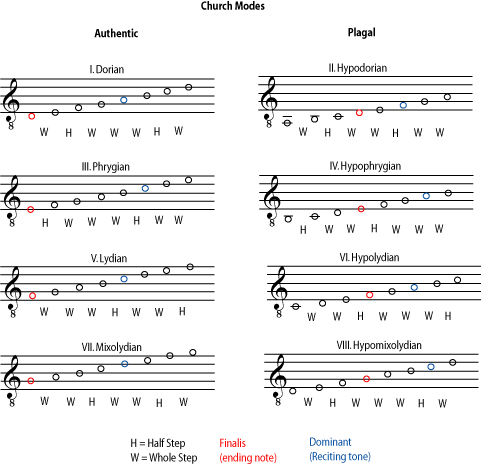 Figure 4: The modes came in pairs
which shared the same finalis.
Figure 4: The modes came in pairs
which shared the same finalis.
|
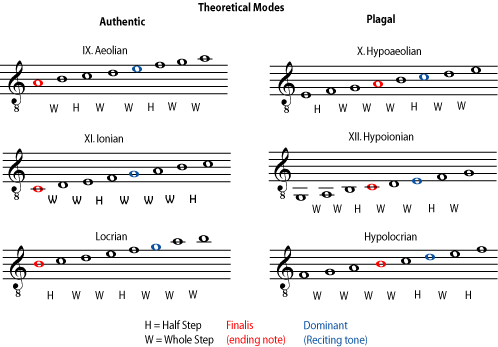 Figure 5: These modes are part of
the same theoretical system as the church modes, but they were not
used.
Figure 5: These modes are part of
the same theoretical system as the church modes, but they were not
used.
|
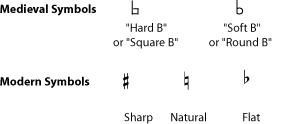 Figure 6: The modern symbols for
sharp, natural, and flat evolved from medieval notation indicating
what type of B should be used.
Figure 6: The modern symbols for
sharp, natural, and flat evolved from medieval notation indicating
what type of B should be used.
|
Modal Jazz and Folk Music
Some jazz and folk music is also considered modal and also uses the Greek/medieval mode names. In this case, the scales used are the same as the medieval church modes, but they do not have a reciting tone and are used much more like modern major and minor scales. Modal European (and American) folk music tends to be older tunes that have been around for hundreds of years. Modal jazz, on the other hand, is fairly new, dating from around 1960. It is important to remember when discussing these types of music that it does not matter what specific note the modal scale starts on. What matters is the pattern of notes within the scale, and the relationship of the pattern to the tonic/finalis. For example, note that the Dorian "scale" as written above starts on a D but basically has a C major key signature, resulting in the third and seventh notes of the scale being a half step lower than in a D major scale. (A jazz musician would call this flatted or flat thirds and sevenths.) So any scale with a flatted third and seventh can be called a Dorian scale.The Ragas of Classical Indian Music
The ragas of classical India and other, similar traditions, are more like modes than they are like scales. Like modes, different ragas sound very different from each other, for several reasons. They may have different interval patterns between the "scale" notes, have different expectations for how each note of the raga is to be used, and may even use slightly different tunings. Like the modal musics discussed above, individual Indian ragas are associated with specific moods. In fact, in practice, ragas are even more different from each other than the medieval European modes were. The raga dictates how each note should be used, more specifically than a modal or major-minor system does. Some pitches will get more emphasis than others; some will be used one way in an ascending melody and another way in a descending melody; some will be used in certain types of ornaments. And these rules differ from one raga to the next. The result is that each raga is a collection of melodic scales, phrases, motifs, and ornaments, that may be used together to construct music in that raga. The number of possible ragas is practically limitless, and there are hundreds in common use. A good performer will be familiar with dozens of ragas and can improvise music - traditional classical music in India is improvised - using the accepted format for each raga. The raga even affects the tuning of the notes. Indian classical music is usually accompanied by a tanpura, which plays a drone background. The tanpura is usually tuned to a pure perfect fifth, so, just as in medieval European music, the tuning system is a just intonation system. As in Western just intonation, the octave is divided into twelve possible notes, only some of which are used in a particular raga (just as Westerners use only some of the twelve notes in each key). But as was true for the church modes, using the pure perfect fifth means that some "half steps" will be larger than others. (If you would like to understand why this is so, please see Harmonic Series and Tuning Systems.) Even though the variations between these different "half steps" are small, they strongly affect the sound of the music. So, the tuning of some of the notes (not the ones dictated by the tanpura) may be adjusted to better suit a particular raga. (Please see Listening to Indian Classical Music and Indian Classical Music: Tuning and Ragas for more information on this subject.)Other Non-Western Modal Musics
To the average Western listener, medieval European chant and classical Indian music are the two most familiar traditions that are not based on major and minor scales. But many other musical traditions around the world are not based on Western scales. Some of these have modes similar to the medieval Church modes; they also tend to be a list of notes (or a pattern of intervals) used with a specific finalis, which may encourage certain types of melodies. While the church mode/jazz mode tradition features diatonic modes (which can be played using only the white keys of a piano), non-Western modes may use other types of scales. Other traditions feature raga-like collections of related melodies, phrases, and ornamentations that are traditionally played with a certain set of notes tuned in a certain way. (Some non-Indian traditions even use the term raga). All of these musics have long traditions that are very different from the familiar major-minor tonal system, and usually also have a different approach to harmony, rhythm, and performance practice.Bibliography
Donald Jay Grout's A History of Western Music introduces both Greek and medieval modes. Lee Evans's Modes and Their Use in Jazz is both comprehensive and accessible for any musician who wants to begin to study that subject. Unfortunately, I have not yet found a good introduction for Western musicians to ragas.
All the information in this website not directly sent by their authors, has been compiled from other sites in the Internet. When possible, the author and source has been indicated.
For any inclusion, comment or suggestion, please write to email[at]early-music[dot]info